









Best Seller
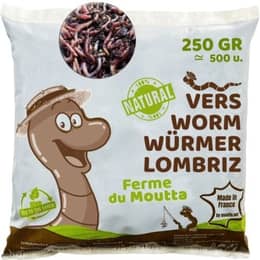
Eisenia compost worms | 250 g of worms (approx. 500 pcs)
Packs from 250 g to 10 kg of worms
€15.40
-25%
Fast and odourless, compost worms eat your waste and turn it into worm casting for your plants.

From 2 to 4 trays, with an optional planter.

Up to 18 growing areas around a central wormery.

Terracotta with flower pot.

2 to 4 trays with a lower shelf.

Trays you add over time, for easy harvesting of vermicompost.

Turn your planters and flower beds into a wormery: WORMacotta, In-Ground.
From the kitchen to the garden, your compost becomes simple, quick, and effective for everyone.
Live animals (worms and bait) and products to feed and look after pets and farm animals.

Eisenia compost worms for your wormery or composter.

Ultra-fresh worms: Compost, Dendros and Canadian from 100 g up to 1 kg.

Natural solutions dedicated to the wellbeing of horses, ponies and donkeys.

Optimise the health and performance of your farm.

Mealworms, natural and nutritious supplements.
Enhance your home with our decorative items and care for your house in a natural and sustainable way.
Tend your garden in an eco-friendly and nature-conscious way, for healthy and lasting plantings.
EM-based products created to enrich soils, protect plants, support animal health, and make everyday well-being and maintenance easier.

Contains a blend of 80 families of beneficial microorganisms.

Revitalise, purify and improve water quality in all your applications.

Stimulate soil microbial activity and plant growth.

Cleanse and maintain your environment naturally.

For the wellbeing and health of pets, livestock and horses.

Enrich your body care or dietary routines with essential enzymes.
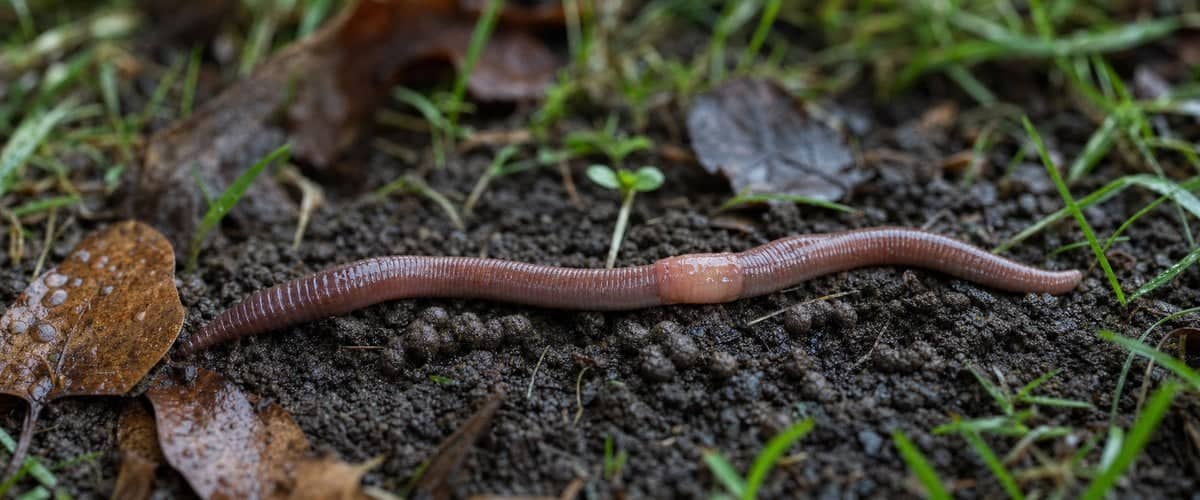
You come across it after a shower, when turning over a spadeful of soil or at the bottom of a wormery: the earthworm is one of those animals everyone knows… without really knowing it. No eyes, no lungs, several ‘hearts’, a body made of rings: this little soil dweller holds plenty of surprises.
Here are the essentials about the earthworm, explained simply — for the curious, gardeners, children and teachers alike. For each topic, we point you to the guide page that covers it in detail.
The earthworm is a small invertebrate animal, meaning it has no skeleton, which lives in the soil or in decomposing organic matter. It belongs to the large group of annelids, the ‘ringed worms’, recognisable by their bodies made up of a series of segments.
In everyday English, we tend to say earthworm or simply worm, whatever the species. Strictly speaking, the lobworm is the large worm of our gardens, Lumbricus terrestris, also known as the common earthworm, though the name is often used loosely for any big earthworm. It is the worm you are most likely to spot on the lawn after heavy rain, because it comes up to the surface when the soil is waterlogged.
There is a great variety of them: around 4,400 species of earthworm have been recorded worldwide to date, ranging from a few centimetres to more than a metre long for some giant species.
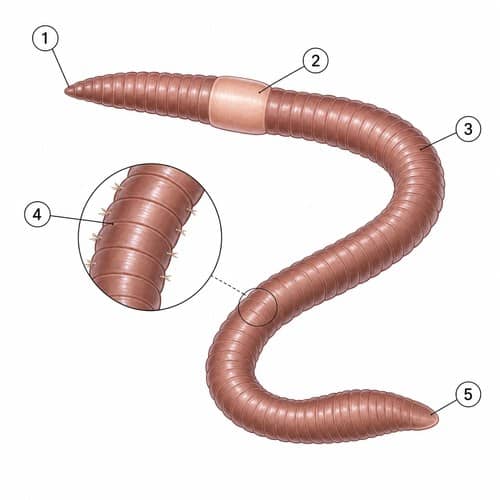 Behind its very simple appearance, the earthworm is a surprisingly well-organised animal. On the diagram: 1 the head and mouth, 2 the clitellum, 3 the rings, 4 the bristles (enlarged), 5 the tail.
To move forward, it contracts and stretches the different parts of its body in turn, a bit like an accordion, using its bristles to stop itself slipping. More curiosities await you in the frequently asked questions at the bottom of the page.
Did you know?When summer becomes too dry, some earthworms go dormant: they curl up into a ball in a small chamber at the bottom of their burrow and wait for the rain to return.
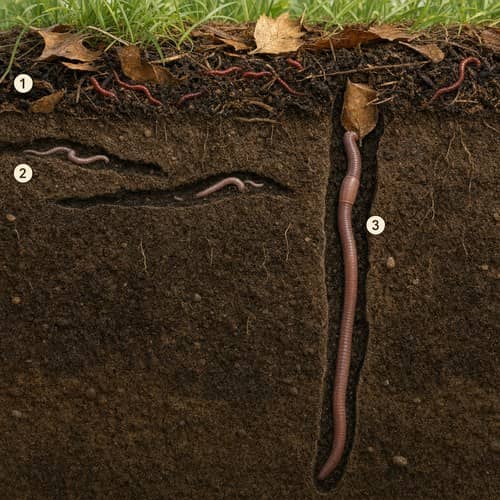 Not all earthworms live in the same place or in the same way. They are usually divided into three main groups, according to the depth at which they live (numbers on the illustration):
Each group benefits the soil in different ways: we come back to this a little further down.
The earthworm feeds on decomposing organic matter: fallen leaves, plant debris, manure, as well as the bacteria and fungi that grow on them. Having no teeth, it swallows small particles that have already softened, which its gizzard then grinds with the help of tiny grains of soil. A compost worm can eat the equivalent of half its own weight each day. To find out what to feed it in a wormery, and what to avoid, see our page What do earthworms eat?
The earthworm is a hermaphrodite: each individual is both male and female. Yet it still needs a partner: two worms lie side by side, head to tail, and exchange sperm. A few days later, the clitellum forms a small cocoon, the size of a grain of rice, from which young worms will hatch after about three weeks. The whole cycle is explained in our page How do earthworms reproduce?
It all depends on its environment. In the wild, most worms live and die within a single year, faced with cold, drought or predators (birds, moles, hedgehogs…). Sheltered from these dangers, in a well-kept wormery, their life expectancy increases considerably: Eisenia fetida compost worms have been monitored in captivity for up to four and a half years. We come back to these figures in our FAQ.
The earthworm is one of the gardener’s best allies. By digging its burrows, it aerates the soil and helps water seep down to the roots. By digesting organic matter, it turns it into nutrients that plants can absorb. Its droppings, the little coils of soil you see on the surface, are an excellent natural fertiliser. Soil rich in earthworms is almost always living, fertile soil.
This quiet work is described in detail in our page on the ecological role of earthworms. And if your soil is short of them, find out how to reintroduce worms into your garden.
Key pointsWeedkillers, pesticides and digging too deeply greatly reduce earthworm populations. A garden fed with compost and mulched, on the other hand, gives them food and shelter.
It is a common mix-up: the large earthworm you find when digging the garden is not suitable for a wormery. Used to burrowing deep and feeding on soil, it does not survive in a bin filled with fresh waste.
To compost your kitchen waste, you need epigeic worms, the compost worms of the genus Eisenia: they naturally live in decomposing matter, process it quickly and breed fast in a confined space. We introduce them in our page Which type of worm for your wormery? To get started with the right worms, you can also buy live compost worms: our Eisenia compost worms are bred on the farm and sent as a mix of three species.
Willy's tipDon’t take worms from your garden to start a wormery: they are not the right ones, and they are far more useful where they are, working your soil.
Can you cut a worm in two to get two worms? Why does it come out of the ground when it rains? Can it swim? The answers are in our earthworm FAQ.
A lobworm is an earthworm. The name mainly refers to the large worm of our gardens, Lumbricus terrestris, but it is often used for any large earthworm.
Compost worms measure a few centimetres, the large earthworm of our gardens can exceed 20 cm, and some giant species, notably in Australia, are more than a metre long.
When the cold sets in, it moves deeper into the soil, safe from frost, and slows down its activity. It comes back up towards the surface in spring, when the soil warms up.
In soil rich in organic matter, under dead leaves or in a compost heap. If you would like to buy some, choose worms suited to your needs: compost worms such as Eisenia for a wormery, or worms suited to the garden to enrich your soil. We breed both at the farm: our compost worms for wormeries and our worms for the garden and outdoor composter.
The earthworm is an annelid with no eyes or lungs, which breathes through its skin and has several small hearts. There are around 4,400 species, divided into three main groups according to the depth at which they live. Everywhere, it transforms organic matter and maintains soil fertility. For a wormery, it is not garden earthworms you need, but epigeic compost worms such as Eisenia.


 France
 Belgium
 Switzerland
 Germany
 United Kingdom
 Italy
 Spain
 Netherlands
 Portugal
 Sweden
 Finland
 Denmark
 Greece
 Poland
 Romania
 Czech Republic
 United States
