Wormery Transfarmers
Flower pot with Wormery
173,22 €
Fast and odourless, compost worms eat your waste and turn it into worm casting for your plants.

From 2 to 4 trays with optional planter.

Up to 18 growing zones with central wormery.

Terracotta with flower pot.

From 2 to 4 shelves with a low shelf.

Urbalive, Worm Cafe, WORMcube, Tiny Worm, WORMwood, ...

Turn your planters into a Wormery: WORMacotta, In-Ground.
From the kitchen to the garden, your compost becomes simple, quick, and effective for everyone.
Live animals (worms and bait) and products to feed and look after pets and farm animals.

Compost worms Eisenia for your wormery or worm compost bin.

Ultra-fresh worms: Compost, Dendros and Canadian from 100 g up to 1 kg.

Natural solutions dedicated to the well-being of horses, ponies, and donkeys.

Optimise the health and performance of your farm.

Mealworms, natural and nutritious supplements.
Enhance your home with our decorative items and care for your house in a natural and sustainable way.
Tend your garden in an eco-friendly and nature-conscious way, for healthy and lasting plantings.
EM-based products created to enrich soils, protect plants, support animal health, and make everyday well-being and maintenance easier.

Contains a blend of 80 families of beneficial microorganisms.

Revitalise, purify and improve water quality in all your applications.

Stimulate soil microbial activity and plant growth.

Cleanse and maintain your environment naturally.

For the well-being and health of pets, livestock, and horses.

Enrich your body or dietary routines with essential enzymes.
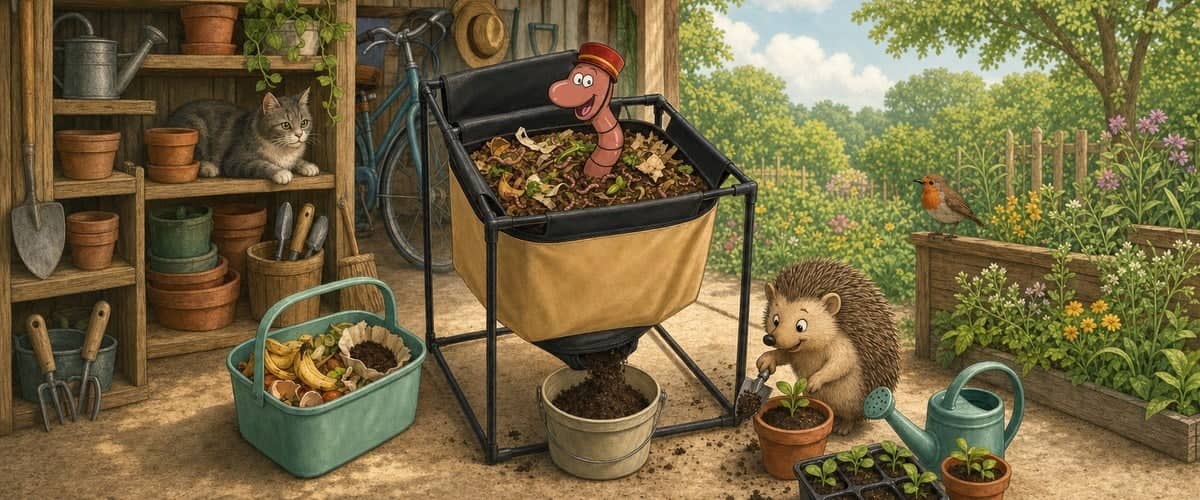
Alongside the stacking-tray model, described in our guide The stacking-tray wormery, there is a second major family of wormeries: continuous-flow models. The principle is different but just as effective, and it particularly appeals to households that produce a larger volume of waste.
Unlike the stacked-tray system, the continuous-flow wormery is based on a single large bin, usually taller than it is wide. You add your waste at the top, just as with a tray model. But instead of the worms moving up from one level to the next, it is the material itself that gradually moves down: fresh waste stays at the surface, where most of the worms gather to feed, while older, already digested material slowly sinks towards the bottom of the bin as more is added.
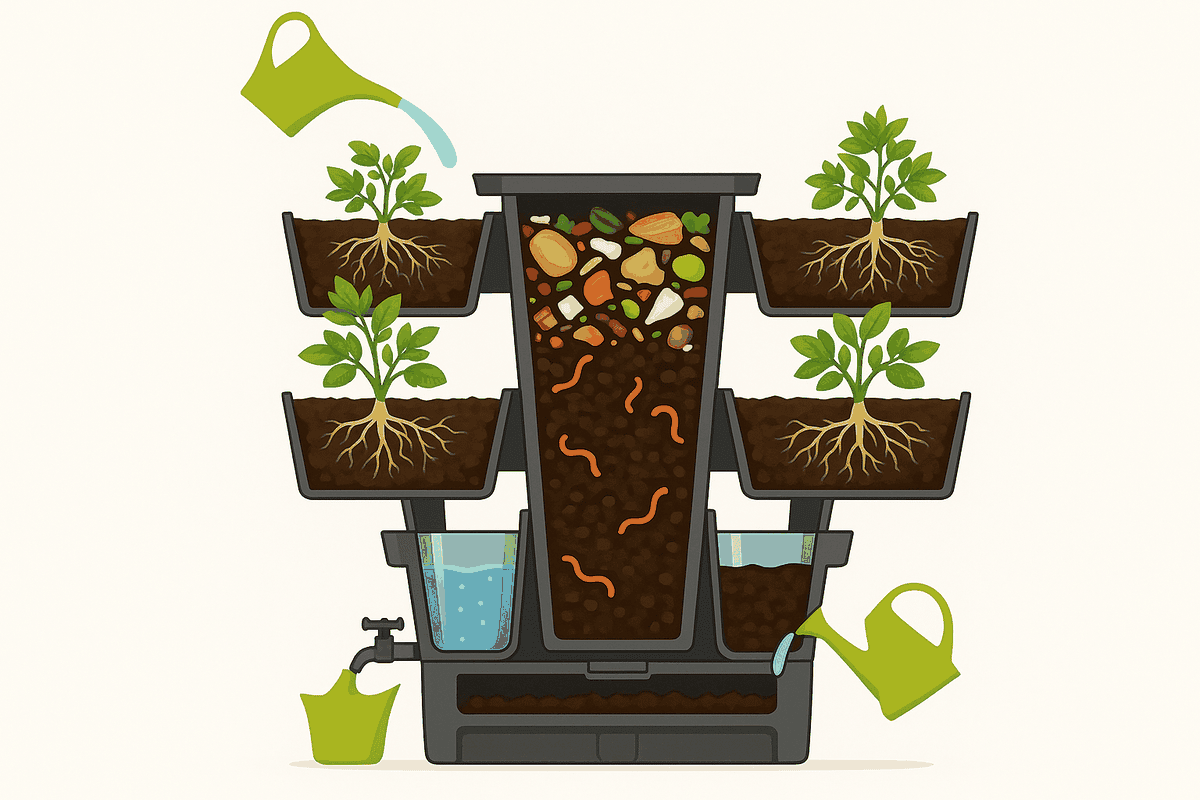
At the bottom of the bin there is a grid or a set of removable bars. When the compost at the bottom is mature, you simply harvest it through this grid, without having to open or move anything else.
Key pointsThe continuous-flow principle can be summed up in one image: the material makes its own way from top to bottom, while the worms stay concentrated near the surface, where the fresh food is.
 This is the great strength of the system: because compost worms naturally stay in the upper layers, close to the fresh waste, the mature compost harvested from the bottom of the bin contains hardly any. You therefore collect fine vermicompost, ready to use, without having to sort out the worms one by one, as can be necessary with other harvesting methods.
This system has several advantages over the tray model. Its larger capacity makes it a sensible choice for a large household or a substantial volume of waste. Harvesting can be done continuously, a little compost at a time, rather than in large batches several months apart. And as there are no trays to add or rotate, day-to-day handling is simpler: you feed at the top and harvest at the bottom, with no other steps.
Key pointsHarvesting without disturbing the worms, feeding without levels to manage: continuous flow simplifies the routine, at the cost of a footprint that is generally more vertical than a tray model.
This format also has its own particularities worth knowing about. Its considerable height requires a little more vertical space than a tray model, and adding waste at the top can be less convenient if the bin is tall. The material can also become compacted in a large vertical volume: it is advisable to mix the upper layers occasionally to maintain good aeration, which is essential for the worms and micro-organisms to work properly. Finally, harvesting from the bottom takes a little practice at first, while you find the right extraction rhythm.
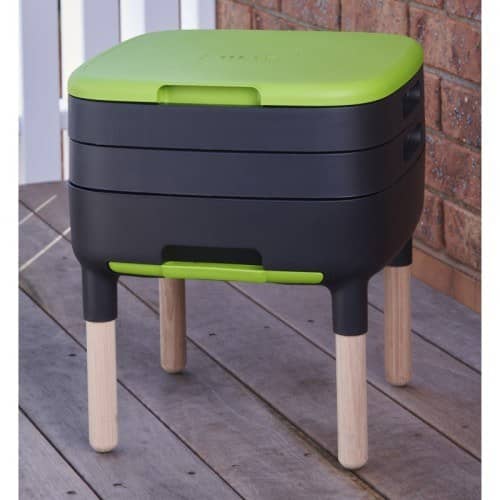 Tray model: several stacked bins
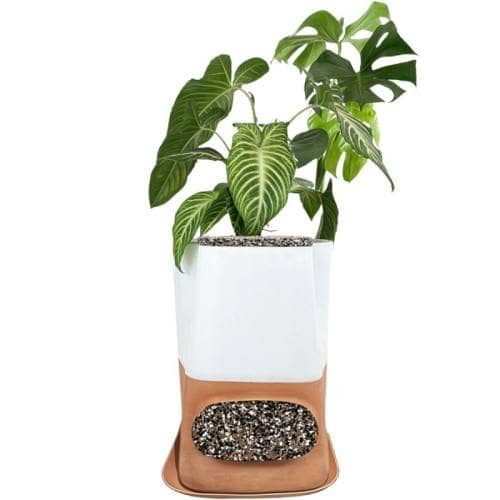 Continuous-flow model: one bin, one flow
Both systems work very well and rely on the same biological principle: it is mainly the space you have available, your volume of waste and your habits that will guide your choice. The tray model, more modular and more visual, is well suited to beginners or a medium-sized household. Continuous flow, with a smaller footprint but greater height, tends to win over households with a large volume of waste or those who prefer regular harvesting rather than in batches. Browse our full range of wormeries to compare the models available in both systems, and see our guide How to get your wormery started for the next step.