











Best Seller
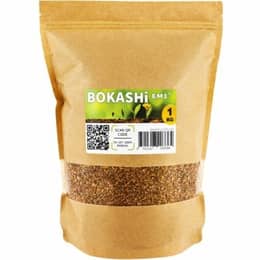
Bokashi EM compost activator | 1 kg bag
Individually or in sets of 2 or 3 bags
€8.15
Fast and odourless, compost worms eat your waste and turn it into worm casting for your plants.

From 2 to 4 trays, with an optional planter.

Up to 18 growing areas around a central wormery.

Terracotta with flower pot.

2 to 4 trays with a lower shelf.

Trays you add over time, for easy harvesting of vermicompost.

Turn your planters and flower beds into a wormery: WORMacotta, In-Ground.
 Practical guide

From the kitchen to the garden, your compost becomes simple, quick, and effective for everyone.
 Practical guide
 Practical guide
Live animals (worms and bait) and products to feed and look after pets and farm animals.

Eisenia compost worms for your wormery or composter.

Ultra-fresh worms: Compost, Dendros and Canadian from 100 g up to 1 kg.

Natural solutions dedicated to the wellbeing of horses, ponies and donkeys.

Optimise the health and performance of your farm.

Mealworms, natural and nutritious supplements.
Enhance your home with our decorative items and care for your house in a natural and sustainable way.
Tend your garden in an eco-friendly and nature-conscious way, for healthy and lasting plantings.
EM-based products created to enrich soils, protect plants, support animal health, and make everyday well-being and maintenance easier.

Contains a blend of 80 families of beneficial microorganisms.

Revitalise, purify and improve water quality in all your applications.

Stimulate soil microbial activity and plant growth.

Cleanse and maintain your environment naturally.

For the wellbeing and health of pets, livestock and horses.

Enrich your body care or dietary routines with essential enzymes.
 Practical guidePractical guide

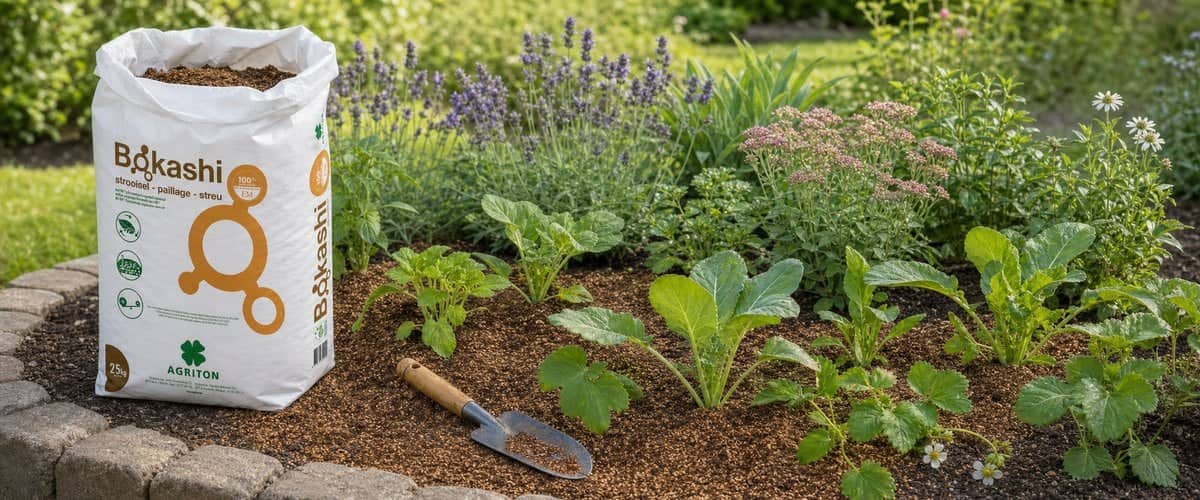
You may have come across the word "bokashi" on a bag of mulch, on clay balls for ponds or in an article about a fermented fertiliser from Latin America. At first glance, none of this has anything to do with the bucket in your kitchen. Yet it is the same word, and the same starting idea: fermenting organic matter before returning it to the soil or the water.
This overview will help you find your way: what each "bokashi" covers, how it is made and what you can reasonably expect from it. Mulch and pond balls each have their own detailed guide in our section on effective micro-organisms.
In the garden, the word bokashi can refer to:
 the method of fermentation itself;
 the activator, the fermented bran you sprinkle over the waste in the bucket;
 the end product, whether fermented kitchen scraps, manure, grass or green waste;
 ready-to-use products: mulches, fermented fertilisers, pond balls.
What they have in common: organic matter, often bran, manure or plant material, inoculated with fermentation micro-organisms. Yet the differences between them are considerable. Some ferment without air and without heating up, like the kitchen bucket; others rise in temperature like a compost heap.
In Central and South America, bocashi, spelt with a c, is a solid fertiliser made on the farm. It typically combines poultry manure, soil, bran or rice flour, crushed charcoal, rice husks, molasses, and yeast or micro-organisms gathered in the forest. The heap is moistened just enough: a squeezed handful should hold together without dripping.
What follows is nothing like an airtight bucket. The heap heats up to between 45 and 65 °C depending on the recipe, and it is turned regularly, sometimes twice a day, to stop it overheating. It is ready in about two weeks, often followed by a maturing period before spreading. So it is a cousin of hot composting far more than of kitchen bokashi.
This bocashi is by far the most studied: a review of the scientific literature identified 161 publications between 1999 and 2022, mainly from Brazil, Indonesia and Mexico. Bear this in mind when you read that "a study has shown that bokashi…": it is often this farm fertiliser, not your bucket. If poorly matured, it can even harm crops: in one trial, three manure-based bokashis were neither stable nor mature, and all of them markedly slowed germination. To find out what studies say about kitchen bokashi, see Bokashi and EM: what the science really says.
In Europe, farm bokashi follows the logic of the kitchen bucket instead, on a large scale: manure, grass, leaves, crop residues or green waste are fermented without air. The method put forward by Agriton, the maker of Microferm, calls for roughly 2 litres of Microferm, 12 kg of shell lime and 12 kg of clay minerals per tonne of material. Everything is mixed, compacted, then covered with an airtight tarpaulin for at least eight weeks before spreading. At these volumes, you can also make your own solution: EM-1 activated in a heated tank such as our EM Activator, following the method in our guide Activating EM-1: making your own EM-A.
Shell lime, which is coarse and slow-acting, helps temper acidity, especially with sugar-rich materials such as grass. The manufacturer advises against fine lime, however, as it is considered too harsh on the micro-organisms. It was on this type of heap that the lowest losses of matter and nitrogen were measured compared with conventional compost.
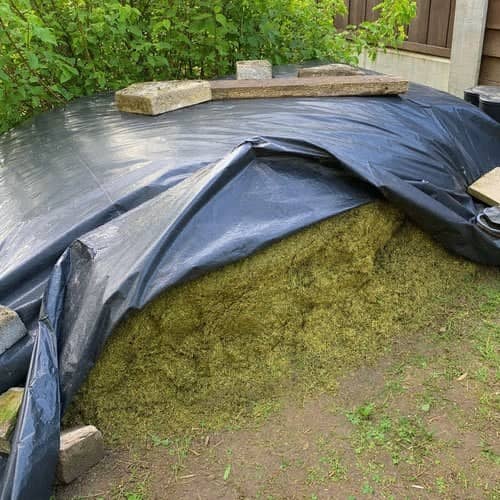 In the garden, the same method lets you make use of the grass clippings you collect. The principle, as described by the manufacturer: spray diluted EM onto the grass while mowing or just afterwards, mix well, gather into a heap, compact it firmly, then cover with a tarpaulin. After about six weeks without air, the fermented grass can be used as a soil improver, mixed into the soil or dug in like kitchen bokashi.
Two precautions. Avoid sodden grass, which tends to rot instead of fermenting. And don't use clippings from a lawn treated with weedkiller: some residues survive even composting. Doses and step-by-step instructions are in our guide Speeding up your compost with EM (and using grass clippings).
Emy's tipCompact the grass heap by treading it down layer by layer, then weigh down the edges of the tarpaulin with stones or soil so that no air can creep in.
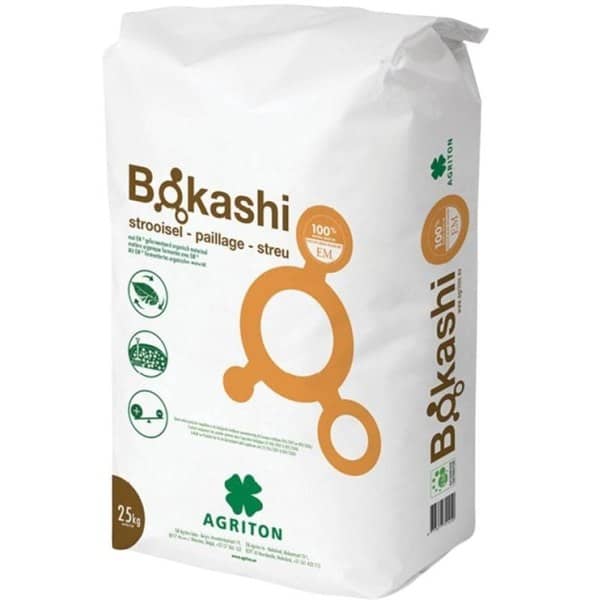
Bokashi mulch is a ready-to-use commercial product: organic matter fermented with EM, designed to be spread on the soil. Don't confuse it with the contents of your kitchen bucket. Those, acidic and moist, are never spread on the surface: they are dug in, mixed with soil, as explained in our guide Burying your bokashi in the garden.
Our EM Bokashi Mulch for soil can be used in the vegetable garden, around flower beds or to prepare a lawn, spread and then lightly worked into the soil. Before sowing grass seed, the manufacturer recommends applying it about two weeks in advance. Quantities, timing and what you can expect are detailed in the guide Using EM in the vegetable garden; please also refer to the product label.
Did you know?Grass clipping bokashi works on exactly the same principle as the silage farmers prepare for winter: compacted grass, deprived of air, which keeps thanks to lactic acid bacteria.
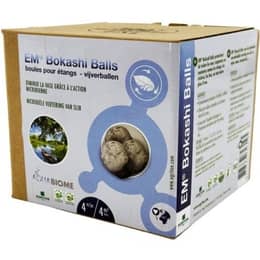
 According to the manufacturer, EM pond balls are made of clay or bentonite, bokashi bran, molasses, Microferm and ceramic powder. Dried and then placed at the bottom of a private pond, they slowly break down in the sludge. The manufacturer credits them with a role in breaking down sludge and odours.
Independent assessments are rare and point in opposite directions. In a stormwater retention pond, ammonium fell by around 65% after the balls were added, but over a short period and with only one ball density tested. Conversely, a two-year trial, presented in 2025 but not yet published in a journal, saw no improvement in the field; in tanks, the balls worsened the water, with far more phosphates, less oxygen and a possible input of bacteria indicating faecal contamination. Our position: sensible use in a private pond, alongside good management of leaves and nutrients, and never in a river, lake or public pond. Everything is explained in the guide Bokashi balls for ponds; our EM Bokashi pond balls come with instructions for use.
All these bokashis share one advantage: they turn organic materials into a stable product that can be stored without rotting and loses little matter until it is used. The benefits for the soil come above all from this organic matter, and trials have not shown any specific effect of the added micro-organisms. So choose the right bokashi for the right use, follow the doses on the label, and keep your expectations realistic.
Key pointsSame family, different uses: the contents of the kitchen bucket and fermented grass clippings are mixed into the soil, commercial mulch is the only one designed to be spread, and pond balls are strictly for private ponds.
The word bokashi covers several fermented products. Latin American bocashi is a fertiliser that heats up and is turned, closer to hot compost; European farm bokashi ferments under a tarpaulin for at least eight weeks; grass clippings can be fermented in the same way in about six weeks. Bokashi mulch is a ready-to-spread soil improver, not to be confused with the contents of the kitchen bucket, which are always dug in. As for pond balls, the few independent assessments are contradictory: they are for private ponds only, never watercourses. In every case, the benefit comes mainly from the fermented organic matter, to be used according to the label and without excessive promises.
Scan the code or visit mouttafarm.ie/guide: all our practical guides, with links to the products mentioned.


 France
 Belgium
 Switzerland
 Germany
 Austria
 United Kingdom
 Italy
 Spain
 Netherlands
 Portugal
 Sweden
 Finland
 Denmark
 Greece
 Poland
 Romania
 Czech Republic
 United States


