











Best Seller
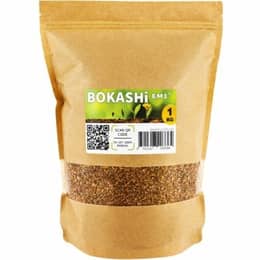
Bokashi EM compost activator | 1 kg bag
Individually or in sets of 2 or 3 bags
€8.15
Fast and odourless, compost worms eat your waste and turn it into worm casting for your plants.

From 2 to 4 trays, with an optional planter.

Up to 18 growing areas around a central wormery.

Terracotta with flower pot.

2 to 4 trays with a lower shelf.

Trays you add over time, for easy harvesting of vermicompost.

Turn your planters and flower beds into a wormery: WORMacotta, In-Ground.
 Practical guide

From the kitchen to the garden, your compost becomes simple, quick, and effective for everyone.
 Practical guide
 Practical guide
Live animals (worms and bait) and products to feed and look after pets and farm animals.

Eisenia compost worms for your wormery or composter.

Ultra-fresh worms: Compost, Dendros and Canadian from 100 g up to 1 kg.

Natural solutions dedicated to the wellbeing of horses, ponies and donkeys.

Optimise the health and performance of your farm.

Mealworms, natural and nutritious supplements.
Enhance your home with our decorative items and care for your house in a natural and sustainable way.
Tend your garden in an eco-friendly and nature-conscious way, for healthy and lasting plantings.
EM-based products created to enrich soils, protect plants, support animal health, and make everyday well-being and maintenance easier.

Contains a blend of 80 families of beneficial microorganisms.

Revitalise, purify and improve water quality in all your applications.

Stimulate soil microbial activity and plant growth.

Cleanse and maintain your environment naturally.

For the wellbeing and health of pets, livestock and horses.

Enrich your body care or dietary routines with essential enzymes.
 Practical guidePractical guide

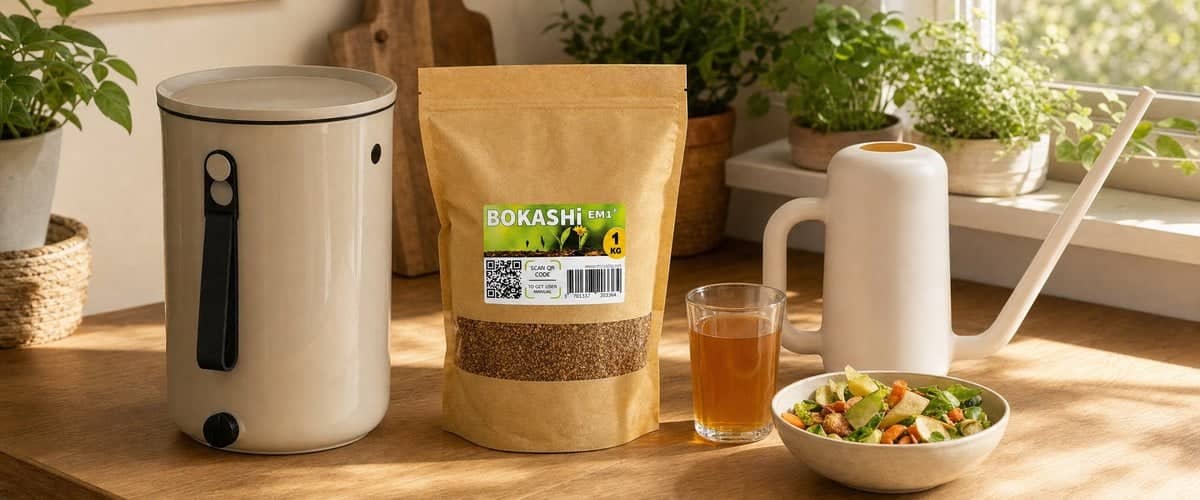
Bokashi raises plenty of questions, especially in the first few weeks. Here are the twenty-five that come up most often. Each answer gets straight to the point and refers you to the guide page that covers the topic in detail.
Key pointsThree rules of thumb answer a great many questions: at least two weeks of fermentation, with the bin full and closed; juice always diluted, at least 1 cl per litre of water; burying at 20 to 30 cm, with at least two weeks' wait before planting.
Not yet. After two weeks in the bin, your scraps are fermented and stabilised, but they keep their appearance: it is an acidic pre-compost. It only turns into soil once it has been handed over to the ground, a composter or worms, which takes between two weeks and two months depending on the season. The whole principle is explained in What is bokashi?.
Yes, as long as you plan where the pre-compost will go. You can turn it into soil in a large container, the famous "soil factory", place it at the bottom of a large pot a few weeks before planting, or give it to a community garden or a gardening neighbour. All the options are in Bokashi without a garden: what to do with your fermented bokashi?.
It is strongly recommended. A full bin must stay closed for at least two weeks: meanwhile, the second one takes your daily scraps. With only one bin, you would have to either throw your scraps away or reopen a bin in the middle of fermentation. How to organise the rotation is explained in Why use two bokashi bins.
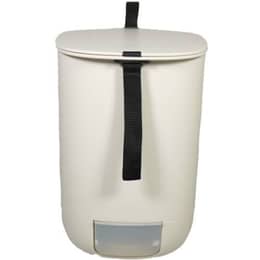
Allow around 10 litres for one or two people and 15 litres for three or four; ideally, a bin should fill up in about two weeks. Above all, a good bin must seal airtight and allow you to drain off the juice. Compare our models in How to choose a bokashi composter, or see how to make your own bin.
With the lid closed, you can hardly smell anything. When opened, a bin that is working well smells sour, like pickles or cider, and the juice smells stronger than the contents. A rotten smell, however, is not normal: it signals a problem that needs fixing. To choose the right spot, read Where to put your bokashi?.
Yes, in fact it is one of bokashi's great strengths. Cut these scraps into small pieces and sprinkle a little more bran over anything high in protein. Small bones are fine; large bones, on the other hand, take years to break down in the soil. The full list is in What to put in a bokashi?.
Yes, no problem: lactic fermentation copes very well with their acidity, whereas the worms in a wormery are not keen on them. Simply cut the peel into pieces.
Plastic, including so-called "compostable" bags and packaging, animal droppings and litter, ashes and diseased plants. Also avoid liquids (soup, milk, oil in large amounts), large bones, shellfish and food that is already rotten or mouldy: they compromise fermentation or barely break down at all.
Never. Bokashi works without air, and stirring lets oxygen in, which encourages bad smells and mould. Each time you add scraps, press them down firmly with the compactor or a potato masher, then close the lid straight away. Good practice is described in Starting your first bokashi bin.
Allow a dose of 15 to 20 ml per 3 to 5 cm layer of waste, a little more for meat, fish, very moist scraps and in cooler weather. Too little bran is a common cause of failure; a slight excess, on the other hand, does not hinder fermentation, it is simply wasted. If in doubt, add a little more. Adjustments are explained in Bokashi bran: role, dosage and storage.
Without an activator, lactic fermentation can start on its own, but the result is much less predictable and the bin is more likely to rot. The very purpose of the activator is to establish the right bacteria quickly. You can use our Bokashi EM compost activator, made on the farm, or prepare your own with wheat bran, EM-1 and molasses (beet or cane), following Making your own bokashi activator.
Allow at least two weeks, with the bin full and closed, in a room between 18 and 25 °C, and one to two weeks longer in cooler weather. This period starts when you close the bin, not when you first add scraps. The waste keeps its appearance: you judge by the sour smell and the softening. Guidelines are in How long does fermentation take?.
Cold slows fermentation down without undoing the work already done: keep the bin indoors, in a temperate room, and add a little more bran. Before you go away, drain the juice, cover the last layer with bran and close the lid tightly: a closed bin can wait several weeks. Once fermentation is complete, bokashi can even freeze without harm and be buried when the weather warms up. It is all in Bokashi in winter, in summer and during the holidays.
Yes, very often. The amount depends on what you put in: lots of juice with fruit and vegetables, very little with bread and cooked leftovers, and less in winter. A new bin may also take one to two weeks before it starts to drain. As long as the smell stays sour, all is well. See Looking after your bokashi.
At least 1 cl of juice per litre of water (1:100) for established plants, and 1 to 2 ml per litre (1:1000 to 1:500) for seedlings and young plants. Pour it at the base of the plant, on soil that is already moist, never neat and never on the leaves. Watering once a week, or once a fortnight, is enough. Details in Bokashi juice: dilution, uses and limits.
Use it within 24 to 48 hours: it is a living liquid that changes quickly. If you have some left over, pour it down the sink or the toilet, followed by a little water, rather than throwing it away. Do not, however, expect it to unblock drains or maintain a septic tank: no study has shown this.
No. Fermented bokashi is acidic and rich in ammonium: in contact with roots, it can damage them. Bury it 20 to 30 cm deep, mixed with two or three times its volume of soil, about thirty centimetres from roots, and never spread it on the surface. The full method is in Burying your bokashi in the garden.
At least two weeks in warm soil, preferably three or four, and longer in cold soil or in pots. A good rule of thumb: once the sour smell has gone from the soil, the area is ready. For seedlings or delicate plants, wait a little longer.
Yes, in small quantities. Bokashi is acidic: place about a small bowlful, well drained and preferably mostly plant-based, in one corner of the wormery, on a layer of dry bedding, so that the worms can move away from it while it mellows. Crushed eggshells help to correct the acidity. See Bokashi and wormeries.
Yes. Treat it as a green material, acidic and moist: spread it in the heart of the heap, mix it with active compost and cover it with at least as much brown material. For a shared composter, first ask the person in charge for permission: not all of them accept it. See Bokashi and garden compost.
Well-fermented, properly buried bokashi is less attractive than leftovers left in the open, but it is not a repellent, and no study has settled the question. Where rodents are present, bury it at least 30 cm deep and lay fine wire mesh over the area for the first few weeks. See Problems after burying.
A white film is a good sign: fermentation is going well. A few green, blue or black spots point to air or too much moisture: remove them, add bran, press down and drain. If coloured mould takes over the bin and the smell turns putrid, fermentation has failed: bury the contents away from your crops, or put them out for food waste collection, then start again. It is all explained in Mould in bokashi.
A putrid smell almost always comes from too little bran, too much moisture or a poorly closed bin: add bran, press down, drain every day and check the seal. Fruit flies mainly come from the small kitchen bin and a lid that does not close properly. Maggots, for their part, come from flies that laid eggs when the bin was opened or through a gap: remove the few larvae, add bran and close the bin carefully; if there are many, bury all the contents deep and start again. The full diagnosis is in Bad smells, too much juice, fruit flies.
Analyses of household bins show a microflora dominated by lactic acid bacteria, with potentially pathogenic micro-organisms in very small quantities. That said, bokashi is not a sanitising process: it does not heat up. Hence a few simple rules: never any animal droppings, gloves for emptying and burying the bin, and hand washing afterwards. See Bokashi and EM: what the science really says.
No. They are different products that share the principle of fermentation: a ready-to-spread mulch for the soil, clay balls for ponds, or fermented agricultural fertilisers. Only shop-bought mulch is designed to be spread; the contents of your bin, on the other hand, must always be buried. See Other kinds of bokashi.
Emy's tipSmell your bin when you open it before worrying about how it looks: a sour, pickle-like smell means all is well, even if the waste looks intact or is covered in a fine white fuzz.
Most questions about bokashi are answered by a few simple principles: cut small, sprinkle, press down without ever stirring, close the lid and drain the juice. The full bin ferments for at least two weeks while the second one fills up. The juice is always diluted, at least 1:100. The pre-compost is buried at 20 to 30 cm, mixed with soil, or goes into a composter or to worms, with at least two weeks' wait before planting. A sour smell is a good sign; a rotten smell calls for prompt correction.
Scan the code or visit mouttafarm.ie/guide: all our practical guides, with links to the products mentioned.


 France
 Belgium
 Switzerland
 Germany
 Austria
 United Kingdom
 Italy
 Spain
 Netherlands
 Portugal
 Sweden
 Finland
 Denmark
 Greece
 Poland
 Romania
 Czech Republic
 United States


