











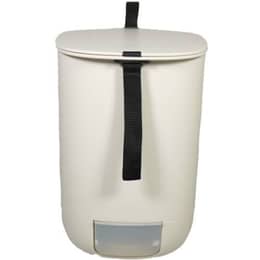
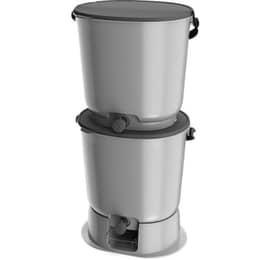
Urbalive Bokashi composter
Capacity 10.6 litres, available individually or in sets of 2
€80.97
Fast and odourless, compost worms eat your waste and turn it into worm casting for your plants.

From 2 to 4 trays, with an optional planter.

Up to 18 growing areas around a central wormery.

Terracotta with flower pot.

2 to 4 trays with a lower shelf.

Trays you add over time, for easy harvesting of vermicompost.

Turn your planters and flower beds into a wormery: WORMacotta, In-Ground.
 Practical guide

From the kitchen to the garden, your compost becomes simple, quick, and effective for everyone.
 Practical guide
 Practical guide
Live animals (worms and bait) and products to feed and look after pets and farm animals.

Eisenia compost worms for your wormery or composter.

Ultra-fresh worms: Compost, Dendros and Canadian from 100 g up to 1 kg.

Natural solutions dedicated to the wellbeing of horses, ponies and donkeys.

Optimise the health and performance of your farm.

Mealworms, natural and nutritious supplements.
Enhance your home with our decorative items and care for your house in a natural and sustainable way.
Tend your garden in an eco-friendly and nature-conscious way, for healthy and lasting plantings.
EM-based products created to enrich soils, protect plants, support animal health, and make everyday well-being and maintenance easier.

Contains a blend of 80 families of beneficial microorganisms.

Revitalise, purify and improve water quality in all your applications.

Stimulate soil microbial activity and plant growth.

Cleanse and maintain your environment naturally.

For the wellbeing and health of pets, livestock and horses.

Enrich your body care or dietary routines with essential enzymes.
 Practical guidePractical guide

"How long do I need to wait?" It's the question everyone asks when looking at their first full bin. And when you search for the answer, you find figures ranging from ten days to six weeks. Enough to make you wonder who's right.
This guide sets things straight: it distinguishes between the different timeframes, explains why sources disagree, gives you our guideline, and above all shows you how to recognise bokashi that's ready, by smell and by sight.
In the life of a bin, there are two quite distinct phases:
 Filling: from a few days to a few weeks, depending on the size of the bin and how much food waste your household produces. Fermentation begins with the very first layers, but the waste on top has only just arrived.
 Resting, with the bin full and sealed: this is the phase referred to as the "fermentation time". It starts on the day you add the last layer, not the day you started filling the bin.
That's why we work with two bins: one fills up while the other rests. The principle is explained in detail in our guide on the two-bin rotation.
Published figures vary by a factor of four:
These differences are easy to explain. Temperature plays a big part: a bin at 25 °C ferments faster than one in a storeroom at 12 °C. So does the type of waste, as well as the way the bin is filled: a bin filled slowly over a month is already well fermented at the bottom, whereas one filled in three days is starting almost from scratch. Finally, some people are talking about fermentation alone, others about the time before you can plant.
Key pointsOur guideline: at least 2 weeks with the bin full and sealed, in a room between 18 and 25 °C. Add 1 to 2 weeks in cold weather. The time it takes to break down in the soil comes on top of this.
Waiting longer is no problem at all. A well-sealed, regularly drained bin stays stable for weeks, even months. On the other hand, cutting the rest short risks leaving you with bokashi that isn't yet properly acidified.
Emy's tipWrite the date of the last layer on the lid in marker pen: that's the date that starts the two-week rest.
After two weeks, open the bin and use your senses. Successful bokashi shows these three signs:
This is the most reliable indicator. Bokashi that's ready smells sour and fermented: gherkins, cider vinegar, sauerkraut, sometimes with a sweet or slightly alcoholic note. The smell is strong when you open the bin, but not nauseating.
It's common to see a white fuzz, like cotton wool, appear on the surface or between the layers. This is a good sign: it goes hand in hand with successful fermentation. Its absence is no cause for concern, though, as long as the smell is right.
The waste has sunk down a little, its colours slightly faded and its texture softer, as if pickled. Everything has settled.
On the other hand, a rotten smell, a smell of rotten eggs or ammonia, a black, slimy sludge or widespread green, blue or black mould all signal a problem. To find out what to do, see our guide on mould in bokashi.
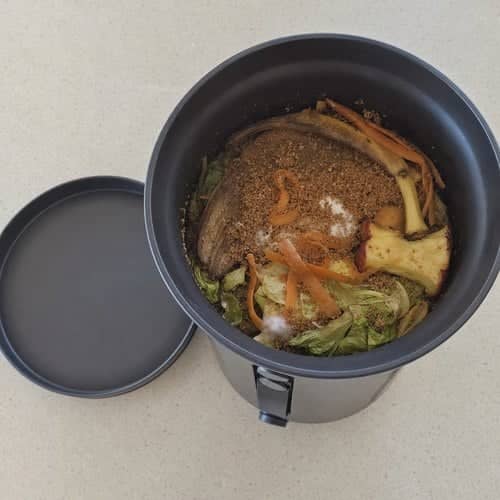 This is the big surprise for beginners: when you open the bin, you can still make out the banana skin, the apple core, the eggshells. It feels as if nothing has happened. Yet that's exactly what's supposed to happen.
Bokashi doesn't decompose waste: it ferments it, rather like making sauerkraut from cabbage. The cabbage keeps its shape in the jar; your scraps keep theirs in the bin too. They are acidified, stabilised and already pre-digested by the micro-organisms. It's a pre-compost, not finished compost. The actual decomposition happens afterwards, in contact with the soil.
Did you know?In household bins analysed recently, the liquid had a pH of 3.7 to 4.9, which is the acidity of orange juice or a tomato. Lactic acid bacteria, the same families found in fermented foods, dominated the microbial population.
The micro-organisms in the bin work faster the milder it is. To keep it simple:
 Between roughly 18 and 25 °C: two weeks is enough in most cases.
 Between 10 and 18 °C: allow an extra one to two weeks.
 Below about ten degrees: fermentation slows down considerably; at around 5 °C, it almost stops. It will pick up again when the bin warms up.
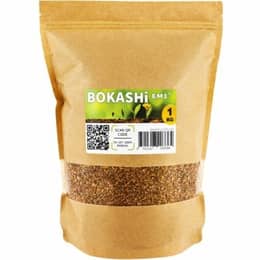
In summer, fermentation is often faster, but still stick to the two weeks: they cost nothing and make the result more reliable. All our seasonal advice is in our guide bokashi in winter, in summer and during the holidays. A good dose of activator, such as our Bokashi EM Compost Activator, also helps fermentation get off to a good start: see our guide on bokashi bran, its role and how much to use.
Once fermented, bokashi still has to turn into soil. Buried in the garden and well mixed with the earth, it generally disappears within two to four weeks, sometimes longer in cold or compacted soil; it's thought to take up to around two months to be fully absorbed. At first it's very acidic, so you need to wait at least two weeks before sowing or planting in the same spot; three to four weeks is even better.
From the first peeling to soil that's ready for planting, you should therefore generally allow six weeks to two months, a little longer in winter. The whole method is explained in our guide to burying your bokashi in the garden, and our guide no garden? covers solutions using pots and containers.
Fermentation time is counted from the last layer: at least two weeks with the bin full and sealed, between 18 and 25 °C, and an extra one to two weeks in cold weather. Waiting longer is no problem at all. Bokashi that's ready smells sour, may have a white bloom and has a softened texture, even if the waste keeps its shape: that's normal, it's a pre-compost. It then turns into soil in the ground, in roughly two to four weeks.
Scan the code or visit mouttafarm.ie/guide: all our practical guides, with links to the products mentioned.


 France
 Belgium
 Switzerland
 Germany
 Austria
 United Kingdom
 Italy
 Spain
 Netherlands
 Portugal
 Sweden
 Finland
 Denmark
 Greece
 Poland
 Romania
 Czech Republic
 United States


